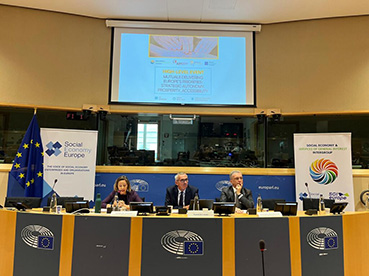
On 8 September, the European Parliament hosted the event “Mutuals at the service of Europe’s priorities: strategic autonomy, prosperity and accessibility”, organised by the Social Economy and Services of General Interest Intergroup together with Social Economy Europe, AIM and AMICE, which placed the role of mutuals as contributors to the achievement of the EU’s strategic priorities at the centre of the discussion.
The event highlighted one of the defining characteristics of mutualism: its ability to combine economic activity with a social purpose. During the opening session, Sarah de Heusch, Director of Social Economy Europe, stressed that the mutual model is based on pooling resources to collectively address individual risks. As she explained, this approach not only protects people, but also makes it possible to reinvest profits in the communities themselves.
Along the same lines, AIM President Yannick Lucas highlighted the role of mutuals as social actors rooted in the principles of solidarity and democracy. For his part, AMICE President Grzegorz Buczkowski emphasised the economic dimension of the sector, arguing that mutuals are far from being a minority model: they represent a significant share of the European insurance market, operate across different sectors and make a significant contribution to economic activity and investment.
Multiple contributions
The first session of the event focused on the contribution of mutuals to a just and resilient transition in the face of climate change, as well as on their ability to channel investment towards sustainability, social cohesion and the resilience of territories.
Jessica Carreno Louro, from Aéma Groupe, argued that the mutual model is particularly well equipped to address these challenges, as it is not subject to shareholder pressure and is able to reinvest resources.
Another major section of the event addressed the ability of mutuals to provide services linked to healthcare and social protection. Representatives from Luxembourg, Portugal and Italy highlighted the presence of these organisations in rural and hard-to-reach areas, as well as their contribution in response to phenomena such as the growing need for long-term care.
The demographic challenge
The demographic transition also occupied a prominent place during the event. Martini Hagiefstratiou, from Solidaris, stressed the need to move beyond a view of demography focused exclusively on ageing and to pay greater attention to healthy life years and to supporting people throughout all stages of their lives. In this regard, she advocated a shift from a healthcare model that is fundamentally curative towards one that places greater emphasis on prevention, understood as a collective responsibility.
One of the most significant messages came during the closing session. Maravillas Abadía Jover, Co-Chair of the European Parliament Intergroup, called for mutuals to cease being regarded solely as organisations to be consulted and instead become genuine partners in the provision of services and the implementation of European priorities.
In the same vein, Idoia Mendia stated that mutuals “are part of the future we want for Europe” and advocated a just and participatory transition in which citizens and social economy organisations play a significant role.
The different contributions therefore converged in calling for greater recognition of the mutual sector as an actor in Europe’s future. From the fight against climate change to healthcare, social protection, ageing, cohesion and strategic autonomy, European mutualism is calling to participate not only in the debate on the Union’s priorities, but also in their implementation, contributing a model based on solidarity, proximity and long-term commitment.