
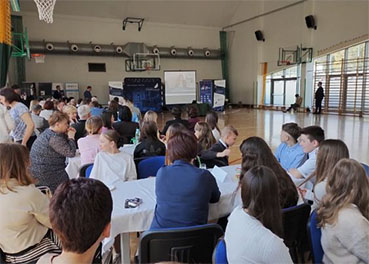
The celebration marking 125 years of student cooperatives in Poland took place on 28 April in Wadowice, the region with the highest number of active student cooperatives in Poland. According to the Polish National Cooperative Council, it is estimated that there are approximately 800 student cooperatives operating in the country.
Student cooperatives embody essential cooperative values such as democracy, solidarity, responsibility and mutual aid, demonstrating that these principles are not reserved for adult life or business environments, but can and should be cultivated from an early age.
They offer an educational experience that goes beyond theoretical learning, providing students with practical opportunities to manage real initiatives, such as running a school shop, organising events or leading community projects. Through these activities, students develop essential skills such as decision-making, teamwork, communication and responsibility.
The approach closely reflects the philosophy of the Polish educator Janusz Korczak, who believed that young people should be active participants in society rather than passive recipients of knowledge. Student cooperatives bring this vision to life by building confidence among students and showing them that their actions can have a tangible impact.
A story of community
In 1900, in the small village of Pszczelin, near Warsaw, the first cooperative was established by the educator Jadwiga Dziubińska, based on a sense of community among the pupils, learning by doing and supporting one another. More than a century later, this idea is still alive and well in many schools.
Behind every student cooperative lies a network of individuals and institutions in which teachers play a crucial role as supervisors and mentors, guiding students whilst allowing them the autonomy to lead.
Organisations such as the Student Cooperative Development Foundation have been instrumental in supporting and promoting the model for decades, providing training, resources and coordination.
This supportive ecosystem highlights that it is cooperation itself that enables student cooperatives to thrive – a shared effort involving educators, institutions, policymakers and the cooperative movement as a whole.
However, expanding the impact of student cooperatives requires the participation of more schools, greater investment in teacher training and resources, the strong integration of cooperative education into national education systems, and the ongoing commitment of the cooperative movement to empowering young people.
Among the figures who have joined in the celebrations is Monica Fantini, President of CECOP (the European Confederation of Industrial and Service Cooperatives), who emphasised that student cooperatives “demonstrate that young people, by working together, can learn, grow and bring about positive change”.