From 3 to 6 November, the Universitat Politècnica de València (UPV) hosted the ICA CCR Europe Research Conference 2026, bringing together the international cooperative research community. Organised by the Centre for Research in Business Management (CEGEA-UPV) under the mandate of the International Cooperative Alliance’s (ICA) Cooperative Research Committee. Under the theme “Cooperative Enterprises for Shared Progress: Tackling Global Challenges Together”, the conference brought together participants from more than 30 countries.
The scientific programme featured 119 papers presented across 26 parallel sessions, as well as 21 posters, covering topics such as governance, innovation, digitalisation, sustainability, legislation, public policy and the different types of cooperatives. The event combined academic exchange with opportunities for dialogue between research and business practice.
Three days of intensive research activity
The conference opened on 3 November with the Young Scholars Day, organised by the ICA CCR-YES network and dedicated to early-career researchers and emerging academics. Entitled “AI and the Future of Cooperative Research”, the event explored the opportunities offered by artificial intelligence for academic work, as well as new methodologies for analysing and measuring the distinctive value of cooperatives.
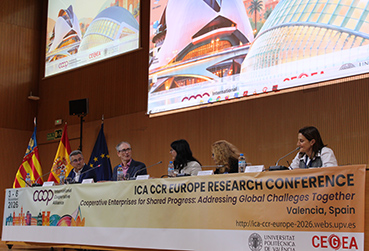
The conference’s official opening took place on 4 November, with the participation of Jos Bijman, President of ICA CCR Europe; Cynthia Giagnocavo, President of ICA CCR Global; Elena de la Poza, Vice-Rector of the UPV; Elena Meliá, Chair of the Organising Committee and member of OIBESCOOP; and Alejandro Monzón, President of Anecoop. They highlighted the importance of these events as spaces for dialogue and debate, and as opportunities to develop new tools to promote the cooperative movement and ensure that the sector occupies the place it deserves on the global stage.
Challenges facing agri-food cooperatives
The opening ceremony was followed by a roundtable discussion entitled ‘The Cooperative Essence: Balancing Traditional Governance with Modern Management’. Moderated by Gabriel Trenzado, Director of Cooperativas Agro-alimentarias de España, the panel featured Antonio Luque, President of Dcoop, the world’s leading cooperative in the olive oil sector; Joan Mir, Director of Anecoop, Spain’s leading fruit and vegetable group; and Lourdes Falcó, President of Cooperativa San Isidro de La Vall d’Uixó and its rural savings bank.
The discussion focused on the main challenges facing agri-food cooperatives: the need to ensure profitability, climate change and the growing number of natural disasters, the spread of pests, generational renewal, land abandonment, and the greater involvement of women in cooperatives’ governing and management boards.
Participants also presented initiatives aimed at encouraging the involvement of younger generations, such as the MuYJoven events promoted by Dcoop and Anecoop’s RELEVA programme, which is designed to train and support new agri-food entrepreneurs. The experience of Cooperativa San Isidro de La Vall d’Uixó in bringing young people and women into its governing bodies was also highlighted.
On 5 November, the sessions explored transdisciplinary research, cooperative identity and legislation, Social Economy statistics, governance, cooperative law, environmental and social sustainability, labour relations and cooperative education. The papers provided insights into the legal, organisational and social challenges facing cooperatives in different international contexts.
That day also saw the presentation of the PortailCoop Awards for Best Papers, sponsored by the platform. The awards recognised two research projects on worker cooperatives. The recipients were Teresa Rodríguez, for a study on the legal framework governing these organisations, and Daniel Aguilar, for research into polarisation processes within them. Both papers addressed issues relevant to understanding the regulatory framework, internal organisation and relationships among members of these cooperatives.
The programme concluded with visits to several cooperative initiatives in the Valencia region: Cooperativa de Viver, Florida Universitària, Anecoop’s Reymos wineries and Consum’s facilities. These visits gave participants an opportunity to discover first-hand a range of cooperative models in the agri-food, education, wine-making and retail sectors