
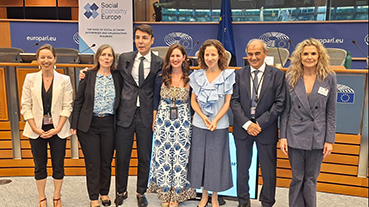
Social Economy Europe (SEE) and the European Parliament Intergroup on Social Economy and Services of General Interest gathered in Brussels for the high-level event “The Multiannual Financial Framework and the Social Economy”, where representatives of the European Commission, the European Parliament, national governments and social economy organisations discussed how the future EU budget can help build a more competitive, resilient and inclusive Europe.
The President of Social Economy Europe, Juan Antonio Pedreño, argued that the debate on the new European budget goes far beyond the allocation of funds, stating that “this is more about values than figures.”
Pedreño warned that the European Union faces challenges such as strategic autonomy, the green and digital transitions, declining competitiveness and rising inequalities, and maintained that the social economy provides an effective response to these challenges. “The social economy is not asking for protection; it is offering a solution to make Europe more competitive, more resilient and more cohesive,” he said.
Along the same lines, Executive Vice-President of the European Commission Roxana Mînzatu stressed that Europe needs an innovative and inclusive economy, recalling that 75% of European citizens consider the social economy essential to their countries’ well-being, according to the Special Eurobarometer on the Social Economy carried out by Eurostat. Meanwhile, Member of the European Parliament Maravillas Abadía argued that this business model must have a clear place both in the next EU budget and in future European policies.
Three priorities for the MFF
During the event, Social Economy Europe presented three priorities for the next Multiannual Financial Framework (MFF): preserving a strong and autonomous European Social Fund; ensuring the explicit recognition of the social economy both in the European Social Fund and in the future European Competitiveness Fund; and creating a dedicated InvestEU window for social investment and capacity building, involving social economy financial institutions.
One of the main topics of discussion was the European Commission’s proposal to simplify the budgetary architecture by integrating different funds into a single framework. Representatives of the sector warned that this model could reduce the visibility of social policies, limit the involvement of regional and local authorities and make it more difficult for investments to respond to the specific needs of each territory.
In this context, Pedreño argued that Europe “cannot finance its security by undermining its social cohesion” and warned that limiting the social economy solely to inclusion policies would be “a strategic mistake”, since this business model is also a driver of competitiveness and development for the European economy.
The need for dedicated funding instruments
For her part, Spain’s Secretary of State for the Social Economy, Amparo Merino, called for dedicated support instruments for the sector, while Member of the European Parliament Isabel Benjumea expressed concern over a budget proposal that, in her view, could weaken policies that have helped reduce inequalities between regions for decades.
Other speakers at the event included Irene Tinagli (Member of the European Parliament and Co-Chair of the Intergroup), Beatriz Sanz Redrado (Deputy Director-General, Directorate-General for Budget – DG BUDG, European Commission) and Alejandro Blanco Fernández (European Court of Auditors).
The event also brought together representatives from the social economy ecosystem, including Baptiste Vasseur (European Network of Social Integration Enterprises – ENSIE), Valentina Patetta (European Federation of Ethical and Alternative Banks and Financiers – FEBEA), Irene Bertana (European Association of Service Providers for Persons with Disabilities – EASPD) and Pascale Zoetaert (ConcertES, the Social Economy platform in French-speaking Belgium), who provided a technical perspective on how future EU funding instruments can better support the social economy and, in doing so, strengthen the values of the European Union and an economy that responds to the needs of people and territories.
More information is available on the Social Economy Europe website