
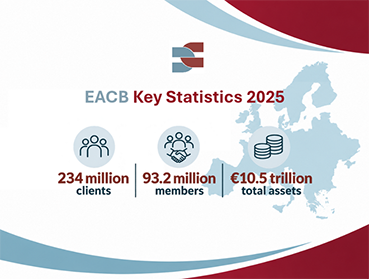
Cooperative banking continues to play a prominent role in the European financial landscape. This is demonstrated by the latest statistics published by the European Association of Co-operative Banks (EACB), which put the number of customers served by these institutions at approximately 234 million, their membership at 93.2 million and their total assets at €10.5 trillion.
The publication, which presents figures for the end of 2025, is accompanied by a research paper prepared by Professor Hans Groeneveld of Tilburg University. The document provides a comparative analysis of the performance and specific characteristics of 18 European cooperative banking groups in relation to their competitors in the capitalist banking sector.
The findings highlight the distinctive features of the cooperative model and its contribution to the European economy, particularly through financing households and businesses, strengthening relationships with members and maintaining positive financial and employment trends.
More financing for the real economy
One of the study’s main findings concerns the share of loans in the asset structure of cooperative banks. Loans account for 54% of their total assets, compared with 38% for other banking institutions.
According to the EACB, this difference reflects cooperative banks’ focus on financing the real economy, with their activities particularly centred on providing credit to households and businesses.
The trend in deposits also confirms this pattern. In 2025, deposits at cooperative banks grew by 3.5%, exceeding the 2.4% increase recorded by other banking institutions. According to the EACB, this performance extends a positive trend observed over a longer period.
Half a million new members in 2025
Strong social roots are another defining feature of the cooperative model. During 2025, European cooperative banks welcomed half a million new members, bringing the proportion of members relative to the population to 21.6%, the highest level recorded to date.
Altogether, these institutions have 93.2 million members and serve approximately 234 million customers, figures that reflect the scale and reach of cooperative banking in Europe.
Employment trends also show positive results. While cooperative institutions recorded a 1% increase in their workforce in 2025, other banks experienced a 1% decline.
These indicators are complemented by the sector’s financial strength. The average Tier 1 capital ratio reached 19.6% in 2025, its highest level to date, according to the data published by the association.
A model with a strategic role in Europe
EACB President Priscille Szeradzki emphasises that the figures demonstrate the strength and relevance of the cooperative model within the European banking system. Szeradzki also highlights its potential in relation to Europe’s objectives of competitiveness, resilience and economic sovereignty. In this context, she believes cooperative banks have an important role to play in mobilising investment and supporting sustainable growth across different regions.
Nina Schindler, Chief Executive Officer of the EACB, similarly argues that these results demonstrate the value of having a diverse banking landscape in which different business models can respond to the needs of citizens and businesses. She therefore considers it essential for the European Union’s regulatory framework to recognise and protect this diversity.
The EACB calls for simpler regulation
The EACB has used these results to reiterate its demands regarding European regulation. Specifically, Nina Schindler points to the need to reduce administrative burdens, simplify regulatory complexity and improve the design of public policies so that all types of European banking institutions can contribute to financing growth.
These demands form part of the EACB’s contributions to the debate on the European Union’s simplification agenda.