Copa and Cogeca have called on EU heads of state and government to strengthen Europe’s farming and livestock sector in the negotiations on the next Multiannual Financial Framework (MFF) and the Common Agricultural Policy (CAP). The call is set out in the Stockholm Declaration, adopted in October 2026 at the organisations’ 12th Congress. The Declaration warns that current budgetary decisions will determine Europe’s ability to safeguard food security, competitiveness and resilience.
The Stockholm Declaration urges EU leaders to maintain agricultural funding, preserve the common nature of the Common Agricultural Policy and strengthen the strategic role of farmers, livestock producers and cooperatives.
The document identifies agriculture, livestock farming and agricultural cooperatives as strategic assets, both for their contribution to supplying quality food at affordable prices and for their role in creating jobs and sustaining vibrant rural communities. It also highlights their contribution to security, strategic autonomy and Europe’s response to climate and geopolitical crises.
At the same time, the declaration warns of a continued decline in the number of farms, rising production costs, market volatility, unfair competition and increasing difficulties of ensuring decent incomes and making long-term investments.
The future of European agriculture
Copa and Cogeca structure their proposal around six main priorities. The first is to recognise agriculture as a pillar of European security and defence.
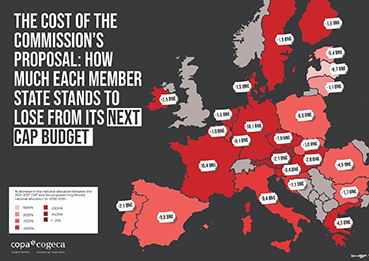
The second calls for the CAP budget to be maintained at least at its current level and adjusted for inflation, with protected and sufficient resources to achieve its objectives.
Thirdly, the organisations advocate preserving the genuinely common nature of agricultural policy, considering it essential to ensuring a level playing field for producers and safeguarding the integrity of the single market. They also warn that the proposed budget governance model could intensify competition among Member States for the available resources.
The fourth priority is to strengthen the competitiveness of the agri-food chain and facilitate investment in innovation, digitalisation, artificial intelligence, water management, decarbonisation and infrastructure. In this context, the European Competitiveness Fund could help finance projects, provided that it complements an adequately funded CAP.
Both the fifth and sixth priorities call for agricultural policy to reflect to the diversity of farms and for administrative requirements to be simplified, as well as for regulatory and financial stability to be ensured in order to encourage investment, production and generational renewal.
The European model
The declaration recalls that the European agri-food sector generates more than one trillion euros in gross value added, according to the figures presented.
It also highlights that farmers and cooperatives have helped maintain food supplies during recent crises and revitalise rural economies.
Through this appeal, Copa and Cogeca aim to ensure that decisions on the future EU budget do not weaken the CAP, but instead consolidate its funding and strategic role in building a safer, more competitive and more resilient Europe.