
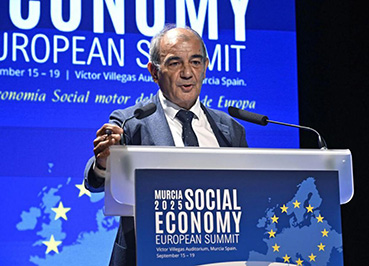
The social economy is playing an increasingly visible role in the debate on Europe’s economic and social future. This is the view put forward by Juan Antonio Pedreño, President of Social Economy Europe and of the Spanish Business Confederation of the Social Economy (CEPES), in a recent article in which he argues for the sector’s strategic importance to the European project.
Pedreño points out that the Social Economy “cannot and must not be relegated to the background. Social and economic wellbeing in all regions depends on it, and it shapes the future of generations to come”. Cooperatives, mutual societies, associations, foundations and social enterprises operate across numerous sectors of the economy and contribute to creating employment, territorial cohesion and services of interest to citizens.
“We are not talking about business profits, nor are we asking for preferential treatment. The figures — and, above all, the tangible social and territorial cohesion that is evident wherever the social economy is present — support the need to continue investing in this model. It is a strategic commitment,” insists the President of SEE.
The sector’s economic dimension is considerable. The European Commission, drawing on the latest report by CIRIEC and Euricse, estimates that there are more than 4.3 million Social Economy organisations in the EU, providing at least 11.5 million jobs, equivalent to approximately 6.3% of total employment. These organisations operate in a wide range of areas, including care, finance, agriculture, food, trade, culture and services.
In his analysis, Pedreño links this reality to some of the European Union’s major objectives. Strategic autonomy, competitiveness, the green transition, digital transformation and social cohesion require, in his view, the participation of businesses and organisations capable of combining economic activity with social objectives.
The author recalls that the European institutions have been developing a specific framework for the Social Economy for years. One of the main milestones was the European Commission’s approval of the Social Economy Action Plan in 2021. Subsequently, the Commission identified the Social Economy as one of the industrial ecosystems relevant to European competitiveness.
This debate has taken on a new dimension in 2026, with the mid-term review of the European Social Economy Action Plan. The European Commission has stated that the sector is an element of the European economy and society and has highlighted its contribution to prosperity, competitiveness and resilience.
Pedreño’s approach therefore places the Social Economy within the major European economic policies. The issue is no longer simply to support social economy entities, but to integrate their experience and governance model into strategies designed to address the European Union’s economic, social, environmental and security challenges.
To this end, the President of SEE identifies three specific priorities. The first: preserving a strong and autonomous European Social Fund, “because it remains the main instrument for investing in people, quality jobs and social inclusion. We cannot allow it to be diluted within broader financial instruments”.
Secondly, that this fund should allocate at least 7% of its resources to specific initiatives for the social economy. This figure is not arbitrary, as it reflects the actual weight of this model in employment.
And thirdly — perhaps the most strategic — SEE calls for the social economy to be fully integrated into the future European Competitiveness Fund. “The model cannot be limited exclusively to the social sphere; on the contrary, it must form part of EU policies on industry, innovation, the green and digital transitions, and strategic autonomy,” says Juan Antonio Pedreño.
SEE additionally calls for the next budgetary cycle to include a tax system consistent with the values of the Social Economy. “A tax system that encourages the reinvestment of profits in the company itself and in the local community, that recognises the importance of putting people before the profits generated by our organisations, and that promotes the creation of cooperatives, mutual societies and social enterprises”.
Pedreño concludes: “We are not asking for privileges. We are calling for intelligent public policies, based on strategy and common sense, because every euro allocated to social economy enterprises has an impact on the real economy, local employment and the cohesion of our cities”.