
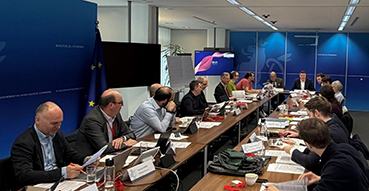
The co-presidents of the Luxembourg Committee, made up of EU governments committed to the Social Economy, Yolanda Díaz, Second Deputy Prime Minister of the Government of Spain, and Serge Papin, French minister, have addressed a letter to the Executive Vice-President of the European Commission, Roxana Minzatu — with copies to the President of the Commission, Ursula von der Leyen; the President of the European Parliament, Roberta Metsola; and the Commissioner for Budget, Piotr Serafin — to convey a shared concern: that the next Multiannual Financial Framework (MFF) 2028-2034, currently under negotiation, should maintain and strengthen ambitious investment in people, cohesion and territorial development, with particular attention to the Social Economy, in a context of transformation and reordering of priorities at global level.
In the letter, the co-presidents of the Luxembourg Committee recall that the Social Economy is “a structural component of the European model by combining competitiveness with cohesion, and growth with social justice.” Far from being a “secondary” field, they stress that it constitutes a leading economic reality in Europe and a key driver for social and territorial resilience, especially in times of uncertainty.
As the restructuring and simplification of EU financial instruments is underway, the letter emphasizes that the European Social Fund Plus (ESF+) is vital for the Social Economy and that, in the new budgetary design, this Fund must retain clear objectives, an identifiable allocation and robust governance, avoiding its dilution within broader frameworks.
Furthermore, the ministers warn of the risk that the objective of dedicating a minimum percentage to social priorities could “dilute” truly effective social spending if investments or infrastructure without direct impact on people are counted as such.
In addition, the ministers request that the Social Economy maintain access to European instruments that have been decisive for its development in recent years — in particular ERDF funds, the CAP, LEADER+, Horizon, InvestEU and SME support programmes such as COSME.
Lastly, both ministers welcome the European Commission’s announcement that it will present in the first quarter of 2026 the results of the mid-term review of the European Social Economy Action Plan, and call for that review to show the highest level of political ambition and adopt a genuinely cross-cutting approach: with effective involvement of all Directorates-General, coherence between strategy and funding, and a clear implementation-oriented approach with measurable actions through to 2030.
Finally, the Luxembourg Committee will closely follow the negotiation of the next Multiannual Financial Framework (MFF) 2028-2034 and encourages the European Commission to ensure that the Social Economy has stable, predictable and properly tailored access to European funding in the next cycle.