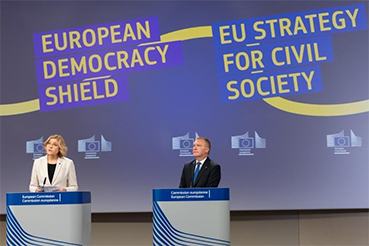
On 12 November, the European Commission presented the EU Strategy for Civil Society, aimed at strengthening engagement with, protection of, and support for civil society organisations, which play an essential role in our societies, as well as the European Democracy Shield, which consists of a set of concrete measures to empower, protect and promote democracies across the EU. Both initiatives had already been announced in President von der Leyen’s State of the Union address last September.
The European Democracy Shield and the EU Strategy for Civil Society put forward measures designed to protect the fundamental pillars of our democratic systems: free people, free and fair elections, free and independent media, a vibrant civil society and strong democratic institutions.
President von der Leyen said of both measures that they “will strengthen the fundamental elements that allow citizens to live our shared democratic values every day: freedom of expression, independent media, resilient institutions and a dynamic civil society”.
The EU Strategy for Civil Society
The new EU Strategy for Civil Society covers three key objectives: fostering participation through the creation of a new Civil Society Platform by 2026 in order to further facilitate dialogue on the protection and promotion of EU values; support and protection through the promotion of an online civic space knowledge hub to facilitate access to existing projects and tools, including available protection measures; and sustainable and transparent funding. In this latter area, in its proposal for the new Multiannual Financial Framework (MFF), the Commission has proposed to significantly increase financial support for CSOs, with €9 billion earmarked for the AgoraEU programme alone.
Initial reactions
In the social economy sector, the first reactions have already been published, such as that of Philea (Philanthropy Europe Association), which has welcomed the introduction of a Civil Society Platform. In this regard, Philea stated that “while details on its creation and operation remain ambiguous, we believe that such a platform should be created in collaboration with civil society, including foundations; it should be a user-friendly and accountable tool, and it should be able to effectively influence EU policy”.
Similarly, Social Platform has welcomed the creation of the Civil Society Platform, stating that it “has the potential to become an important space for dialogue between organisations and to provide a structured framework for the European Commission’s engagement with civil society”.
However, in order to fulfil this role, they explained, the new platform must include the right mix of representative organisations, reflecting the diversity of communities and pan-European civil society, and must go beyond those represented through the European Economic and Social Committee (EESC).
More info, about the Strategy for Civil Society and the European Democracy Shield