
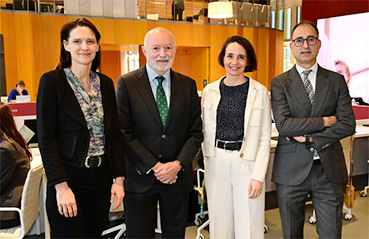
The European Association of Co-operative Banks (EACB) held its 57th General Assembly in Almería, hosted by the Cajamar Cooperative Group. More than thirty representatives from across Europe gathered to decide on matters of strategic importance for the association and to reflect on developments dominating current EU policy debates, which decisively shape the regulatory environment in which co-operative banks operate.
The event also provided an opportunity to celebrate the 50th anniversary of the Las Palmerillas Experimental Station, an internationally recognised technology centre promoted by Cajamar, particularly in the field of greenhouse horticulture in warm climate areas. The milestone was marked by a keynote address from the Governor of the Bank of Spain, José Luis Escrivá, who highlighted the success and resilience of the co-operative business model, as well as the sector’s fundamental role in financing the Spanish economy, particularly sectors such as agriculture, self-employed workers and small businesses. He stated: “Its profitability is comparable to that of the rest of the banking sector, while its solvency position is even stronger. These strengths place co-operative banking in a good position to address the challenges it faces, mainly related to size, governance and the implications of digitalisation.”
During the EACB Assembly, members endorsed several significant governance decisions. Viviana Mitrache-Rimbault from Crédit Agricole was appointed as a representative to the EACB Board, followed by the formal admission of CrelanCo (Belgium) as a new member, further expanding the association’s membership base. In addition, Professor Małgorzata Iwanicz-Drozdowska from KZBS, EACB’s Polish member, was elected as the new Chair of the Cooperative Identity Forum, bringing her extensive academic and sectoral expertise to the platform.
With a view to 2026, members exchanged views on policy issues of particular relevance for co-operative banks in Europe, including agricultural financing, sustainability reporting and the simplification of the EU prudential framework for banks. In this context, EACB members reaffirmed their commitment to preserving the diversity of the banking landscape and to defending their inclusive, resilient and member-focused banking model.
EACB President Priscille Szeradzki concluded: “This meeting reaffirmed not only our leadership in shaping a resilient, innovative and inclusive banking model, but also the strength and continued growth of our association. Looking ahead to 2026, co-operative banks are ready to address new developments and actively contribute to ongoing debates on European sovereignty, ensuring that our way of doing banking remains at the heart of economic progress and aligned with the needs of the communities we serve.”
For her part, EACB CEO Nina Schindler thanked the Cajamar Cooperative Group for hosting the General Assembly “and for its long-standing commitment to co-operative banking in Spain.” As she stated: “The strong collaboration with our Spanish members remains a cornerstone of the EACB’s work, and we look forward to further strengthening our partnership for the continued success of our movement.”