
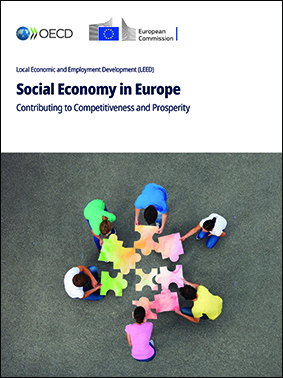
A new joint report by the OECD and the European Commission highlights the growing role of the social economy in Europe, underlining its contribution to job creation, innovation and territorial cohesion. The sector currently accounts for 6.3% of employment in the EU and generates a turnover of more than one trillion euros, according to CIRIEC–Euricse figures, and operates across all sectors of activity.
The report ‘Social Economy in Europe. Contributing to Competitiveness and Prosperity’ was prepared by the OECD Centre for Entrepreneurship, SMEs, Regions and Cities (CFE), led by Lamia Kamal-Chaoui, and forms part of the Centre’s Local Economic and Employment Development (LEED) Programme. It was produced in collaboration with the European Union, within the framework of the commitments set out in its Action Plan for the Social Economy.
The authors of the report are Melis Aslan, Bruno De Menna and Sofija Rakcejeva, policy analysts (CFE/LEED), under the supervision of Amal Chevreau, Head of the Social Economy and Innovation Unit (CFE/LEED).
Care and housing: strategic priorities
The report focuses on sectors such as care and housing, two “critical areas” in the context of population ageing and rising housing costs. In both fields, the social economy offers innovative, affordable and high-quality solutions, prioritising community needs over profit. In the care sector, social economy organisations provide services for older people, persons with disabilities and childcare, reaching even rural areas and improving working conditions for staff.
In housing, social associations and cooperatives already represent significant shares of the housing stock in countries such as the Netherlands (33%), Austria (25%), Sweden (24%), Poland (16%) and Czechia (12%).
Institutional framework, business support and taxation
The report also stresses the need to strengthen institutional frameworks, business support and taxation in order to boost the social economy. Coordination between levels of government facilitates its visibility and local development. In addition, access to seed capital, specialised incubators, tailored tax measures and digitalisation strategies are required to enable these organisations to scale up and maximise their social impact.
In the field of taxation, the report recommends measures such as tax exemptions or reductions, incentives for hiring disadvantaged groups and tax credits that recognise the social value generated. However, the diversity of legal forms and models poses challenges for the implementation of a coherent tax framework, which requires regulatory clarity and a public register of eligible entities.
The report concludes that the social economy not only contributes to employment and social cohesion, but also represents a strategic tool to address Europe’s social and economic challenges, from care and housing to innovation and sustainability, as a competitive sector capable of generating shared prosperity.