
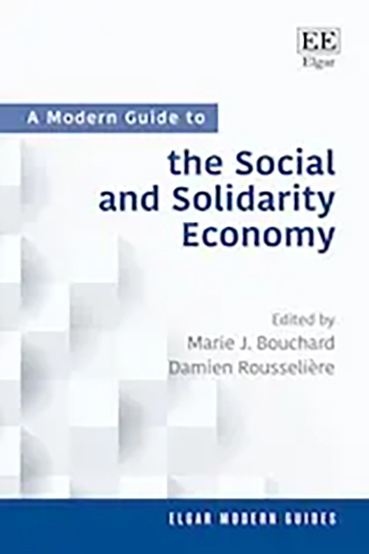
Edward Elgar has released the book A Modern Guide to the Social and Solidarity Economy. With contributions from thirty international experts, under the edition of Professors Marie J. Bouchard (Université du Québec à Montréal and CIRIEC-Canada) and Damien Rousselière (Institut Agro Rennes-Angers and CIRIEC-France), this Guide presents a synthesis of contemporary knowledge on the social and solidarity economy (SSE); it provides an overview of the conceptual, historical, organizational and developmental dimensions of the SSE, and explores current issues from the perspective of public policies, governance, finance and legislation.
The chapters combine theoretical perspectives with empirical examples, offering insights into research, development and participation in the SSE. The various contributions show that the SSE fosters equitable patterns of resource and surplus distribution and promotes democratic, competent and emancipatory power relations. The entities analyzed include cooperatives, mutual societies, non-profit organizations and community initiatives that prioritize social and environmental missions over profit generation.
The book may be of great interest to academics and students of economics and finance, business administration and social policy. And, above all, to SSE stakeholders and policymakers, particularly those involved in sustainable development, public services and local development.
Table of contents
- Introduction to the social and solidarity economy (SSE) field of research, by Marie J. Bouchard, Damien Rousselière, and Carl Cenerelli
PART I. DEFINING THE FIELD OF SSE
- Social and solidarity economy approaches: a brief conceptual analysis, by Marthe Nyssens and Marie J. Bouchard
- Historical perspectives on the institutionalisation of the social and solidarity economy, by Timothée Duverger
PART II. DEVELOPING SSE ORGANISATIONS
- Public policies for the social and solidarity economy, by Rafael Chaves-Avila, Juan R. Gallego-Bono, Belen Catala Estada, and Teresa Savall Morera
- Governing and managing social and solidarity economy organisations, by Roger Spear, Madeg Le Guernic, and Chris Cornforth
- Financing solidarity: building an alternative financial system, by Amélie Artis
- The impact of the laws on the social and solidarity economy on organizational cooperative law, by Sofia Adam, Ifigeneia Douvitsa, and Hagen Henrÿ
PART III. PERSPECTIVES ON THE FIELD OF SSE
- Internationalization of social and solidarity economy organizations, by Anjel Errasti, Ignacio Bretos, and Carmen Marcuello
- The ecosystems of the social and solidarity economy: essential for the challenges of our time, by Marie J. Bouchard, Jean-Marc Fontan, and Benoît Lévesque
- Communal studies and intentional communities: key features and main contributions to the understanding of the social and solidarity economy, by Michel Lallement and Damien Rousselière
- Distinctive characteristics of the social and solidarity economy in Latin America, by Juan Fernando Álvarez, Valeria Mutuberría Lazarini, and Carmen Marcuello
- The social and solidarity economy: the contribution of emergence and the importance of North–South dialogue, by Jean-Louis Laville
- Community economies, transformation pathways and the social and solidarity economy, by Katherine Gibson