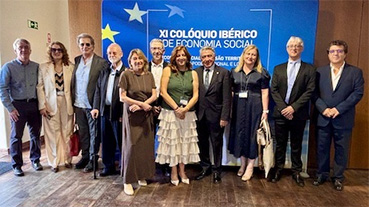
The Portuguese capital, Lisbon, and the town of Caldas da Rainha hosted the 11th Iberian Colloquium on Social Economy from 27 to 29 May. The event was organised by the Portuguese and Spanish sections of CIRIEC under the theme “Social Economy and Territorial Cohesion: The Role of Regional and Local Authorities.” The 11th Iberian Colloquium became a forum for reflection on how public policies, the social economy, and local and regional networks can contribute to retaining population, creating employment, and combating territorial inequalities, among many other benefits for society.
The 11th Iberian Colloquium began on 27 May with a session on mutualism held at the headquarters of Montepio Geral in Lisbon. Speakers included José Alberto Pitacas from CIRIEC-Portugal; Armando Nieto Ranero, Executive President of Mutua Divina Seguros; and Yannick Lucas, representative of Mutualité Française and AIM.
The speakers agreed that mutualism is undergoing a period of strategic redefinition in which financial sustainability must coexist with the preservation of the founding values of solidarity, mutual assistance, and territorial commitment that characterise mutual societies.
The Need to Build Alliances
On the morning of 28 May, the opening session of the Colloquium took place in Foz do Arelho, with the participation of Vitor Marques, Mayor of Caldas da Rainha; Eduardo Graça, President of CASES; Jaime Iglesias, Commissioner for the Social Economy of the Government of Spain (via video message); Professor Luis Reto from the Higher Institute of Labour and Business Sciences; Manuel Belo Moreira, President of CIRIEC-Portugal; and Adoración Mozas Moral, President of CIRIEC-Spain.
The programme continued with a round table on territorial policies to promote the social economy, moderated by Professor Rafael Chaves (Universitat de València and CIRIEC-Spain).
These sessions highlighted that territorial cohesion and programmes to promote the social economy have become shared concerns among the various families of the social economy and academic experts. Participants stressed the need to strengthen alliances between local and national administrations, social economy organisations, and universities in order to address challenges such as increasing precariousness and insecurity, population ageing, and the deterioration of public services.
Thursday afternoon was devoted to the presentation of academic papers. The Scientific Committee approved a total of 45 papers submitted by researchers from universities in Spain, Portugal, and Latin America.
The Importance of Territorial Policies
The closing day of the colloquium took place on 29 May in Foz do Arelho with a round table dedicated to “Territorial Governance and the Promotion of the Social Economy.” Moderated by Inmaculada Carrasco Monteagudo, Professor at the University of Castilla-La Mancha and President of OIBESCOOP, the session featured Hugo Moreira Luís, President of the Municipality of Mafra; Manuel Guerreiro, President of Caixa de Crédito Agrícola de Torres Vedras; Roberto Di Meglio, former ILO specialist in local economic development and the social and solidarity economy; and Cándido Román, Director of the Cajasiete Chair in Social and Cooperative Economy at the University of La Laguna.
Four representatives from very different backgrounds, yet united by the same conviction: the Social Economy requires strong territorial governance in order to become a genuine tool for transformation. In recent years, the sector has benefited from an unprecedented framework of recognition, endorsed by international organisations such as the United Nations. Today, the real challenge lies in its effective implementation at national, regional, and local levels.
The awards ceremony for the best academic papers provided the scholarly conclusion to an event distinguished both by its scientific rigour and by its ability to foster networks of collaboration among researchers, local representatives, and professionals from the sector.