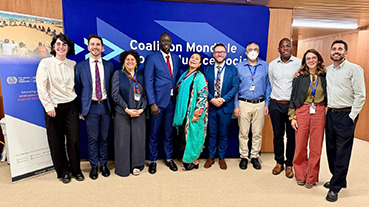
Representatives from approximately 30 governments across all United Nations regional groups attended the launch meeting of the Group of Friends of the Social and Solidarity Economy on June 11 at the ILO headquarters in Geneva, Switzerland. Driven by the Governments of Spain, Brazil and Colombia, the initiative establishes a new intergovernmental cooperation platform to promote the social and solidarity economy at the international level, within the framework of the ILO Global Coalition for Social Justice.
The meeting brought together more than 60 in-person participants and nearly 90 online, with representation from over 30 countries, alongside international organizations, United Nations entities and social economy actors.
During the session, the establishment of the Group was formalized. It is conceived as a voluntary space for dialogue, cooperation and exchange of experiences among governments. All of this aims to strengthen and expand the contribution of the social and solidarity economy to decent work, sustainable development and social justice.
Ministers from Barbados, Côte d’Ivoire, Guatemala, Senegal, the State of Palestine and Uzbekistan took part in the launch meeting, either in person or through video messages. Social partners, social and solidarity economy organizations and networks, United Nations entities and other relevant stakeholders also participated.
Brazil presented the proposed working methods for the Group; Colombia placed the initiative within the broader context of international cooperation on the social and solidarity economy; and Spain, through the Commissioner for the Social Economy, Jaime Iglesias, linked the creation of the Group of Friends “to strengthening intergovernmental dialogue, supporting the ILO and the United Nations ‘Task Force’ team on the Social and Solidarity Economy”.
Also during the meeting, Laura Thompson, ILO Deputy Director-General, highlighted the Organization’s century-long tradition of support for the social economy. She explained that the launch of the new Group of Friends “takes place at the midpoint of the Governing Body’s strategy and action plan on decent work and the social and solidarity economy (2023–2029), which implements the 2022 International Labour Conference Resolution”.
The meeting identified several areas in which cooperation among governments can contribute, including the report of the United Nations Secretary-General on the social and solidarity economy; discussions on a possible new General Assembly resolution; work towards the development of international guidelines on statistics of the social and solidarity economy; and requests from Member States to further explore the link between the social and solidarity economy and social innovation.
Following the launch, governments met informally to discuss the Group’s working arrangements and next steps. Participation in the Group remains open to any interested government, with the aim of strengthening the role of the social and solidarity economy in accelerating the implementation of the 2030 Agenda for Sustainable Development and ensuring that the social and solidarity economy is duly considered in the development of the post-2030 development agenda.