
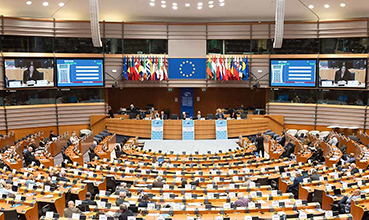
The European Economic and Social Committee (EESC) warns that the marginal increase proposed by the European Commission in the volume of the the Multiannual Financial Framework (MFF) is insufficient and emphasizes the need for a substantial increase in resources. This is stated in Opinion ECO/682 on the 2028-2034 MFF, adopted at the EESC Plenary on 22 January, with rapporteurs Dominika Biegon, Konstantinos Diamantouros, and Luca Jahier. The opinion was approved with 209 votes in favour, 5 against, and 4 abstentions.
In the same opinion, the EESC strongly opposes the proposed reduction of funding allocated to cohesion policy and the Common Agricultural Policy (CAP), stressing that such cuts would undermine the effectiveness of EU policies, which have proven successful in achieving EU objectives.
The EESC also opposes the plan to merge resources for cohesion policy, the European Social Fund Plus (ESF+), the CAP, fisheries, migration, and security into a single fund as currently designed. It considers that this structural change could create distributional conflicts, as cohesion, social, and rural development objectives could be sidelined by short-term priorities in security and migration.
This would weaken final beneficiaries, including cooperatives and the social economy, which rely on secure planning and stable funding structures. The EESC supports a thorough and structural review of the “multi-fund” architecture to ensure predictability and autonomy of the most important spending programs.
The EESC also emphasizes that allocations for social policies must be robust and effective to ensure the effective inclusion of vulnerable groups, such as young people struggling to access the labour market and housing, or workers displaced by accelerated economic transformations.
In line with the demands of Cooperativism and the European Social Economy
With this new opinion, the EESC aligns itself with the demands of cooperativism and the European social economy, which over the past year have called for increased funds for the new MFF, as well as the maintenance of the CAP and ESF+ to consolidate the countless social cohesion and territorial development actions achieved with these resources.
The opinion reflects an integrative approach, where the participation of workers’ organizations, employers, and civil society — EESC components — is deemed essential to design a budget that not only supports the EU’s major political priorities but also responds from the bottom up to the needs of European citizens.
EESC civil society representatives have noted that without an ambitious and adequately funded MFF, the EU risks losing credibility with its citizens, particularly at a time when economic and social challenges are increasingly complex.
Intense negotiation phase
Although the EESC opinion is non-binding, its adoption in plenary strengthens parliamentary debate and discussions with the European Commission and the Council on the final design of the 2028‑2034 MFF.
The European Commission and Parliament must now consider these contributions during the interinstitutional negotiation phase preceding formal adoption of the MFF, a process that will be key to defining EU budgetary policies for the next seven years.