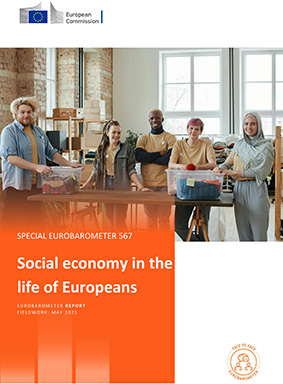
The European Commission, following the Social Economy Action Plan, has carried out a special Eurobarometer dedicated to the social economy in the EU. According to its main findings, the social economy — which includes cooperatives, mutual societies, social enterprises, foundations and associations — plays a prominent role in the lives of Europeans. The study, conducted in May 2025 through more than 26,000 interviews across the 27 Member States, shows that people not only know about this economic model, but also actively participate in it and demand a stronger commitment from public institutions to support and promote it.
The report indicates that 56% of Europeans have heard of the term “social economy”, although only one in five claims to really know what it is about. Familiarity with the concept increases when a common definition is provided: nearly half of respondents then state that they understand this type of organisation, with particularly high levels in Luxembourg, Malta, the Netherlands and Ireland. Associations and foundations are the most widely recognised entities, followed by cooperatives, whereas mutual societies and social enterprises remain less visible to the public.
Once the concept is clarified, 75% of Europeans acknowledge the importance of the social economy for well-being in their country, for environmental protection, and for social cohesion. Consequently, a very significant majority supports policies aimed at developing the social economy, including the creation of specific strategies and appropriate legislation (88%), training and awareness-raising initiatives (86%), assistance for people wishing to create social economy organisations (86%), and direct financial support from the public sector (80%).
Citizen participation in the social economy is broad and diverse. More than half of Europeans state that they have been involved in some way over the past five years, either as volunteers (18% of the European population), donors (18%), customers (15%), or members of an organisation (13%). Four percent of EU citizens say they have worked as employees in a social economy organisation over the past five years, and two percent report having been active as social entrepreneurs.
Furthermore, citizen participation in the social economy is not sporadic among those who have had some link with these organisations. The Netherlands, Sweden and Ireland record the highest levels of regular involvement, while Latvia, Romania and Czechia are at the bottom.
Sectors in which the social economy is most visible
The area where the social economy is perceived as having the greatest impact is health and care, although significant contributions are also recognised in education, culture, the environment, agriculture and housing. In social terms, the fight against poverty appears as the domain in which citizens believe the social economy makes the most decisive contribution.
Despite this generally positive assessment, perceptions of the sector’s level of development vary widely between countries. Half of respondents believe that the social economy is well developed in their country. Luxembourg and the Netherlands top the list of the most optimistic, while Greece and Bulgaria show the highest levels of scepticism regarding its maturity.
Finally, the study observes a strong demand for traditional capital-based enterprises to adopt practices inspired by the social economy. Reinvesting profits into the enterprise’s mission, orienting activities towards social or environmental goals, and involving workers in decision-making are principles widely supported by citizens.
The Eurobarometer concludes that the social economy, despite its varying levels of development across Europe, enjoys a very favourable public perception and citizen support that far exceeds that of other economic models.
The full report (in English), along with summaries, infographics and country-by-country graphs, is available here: https://europa.eu/eurobarometer/surveys/detail/3356