The Second African Forum for the Social and Solidarity Economy (FORA’ESS Dakar 2026) will take place from 7 to 9 July 2026 in Dakar, Senegal, with an expected participation of around 2,500 stakeholders representing approximately 30 countries from Africa and other regions of the world.
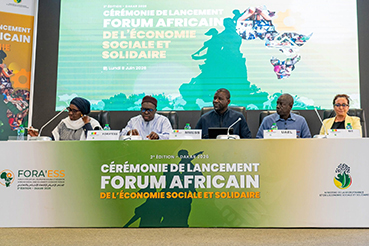
FORA’ESS 2026 was officially launched on 6 June in Diamniadio during an event chaired by Senegal’s Minister of Microfinance and Social and Solidarity Economy, Alioune Dione. In his speech, the minister emphasized the strategic importance of this international gathering, noting that it confirms the vitality of the African social and solidarity economy movement.
In his view, it also perfectly illustrates Senegal’s ongoing commitment to fully playing its role as a facilitator and promoter of an economy fundamentally based on solidarity, inclusion, and cooperation among peoples.
In recent years, Senegal has established itself as a key actor deeply committed to promoting the social and solidarity economy (SSE) at both continental and international levels. The country has made a significant contribution to the global efforts that led to the official recognition of the SSE by the United Nations as a key component of sustainable development. At the national level, Senegal has adopted a specific legal framework, a governing law, and a national strategy dedicated exclusively to this sector. This momentum is aligned with the broader vision of the President of the Republic, Bassirou Diomaye Faye, who has officially declared 2026 as the “Year of the Social and Solidarity Economy and Employment.”
The Forum’s President, Malick Diop, presented the vision for FORA’ESS 2026, while its scientific pillars were outlined by Professor Sambou Ndiaye. Territorial engagement was represented by Imam Cheikh A.T. Seck, along with other local authorities. For her part, Samira Daoud, Director of the ILO Technical Team for Decent Work, confirmed the strategic support of technical and financial partners. Inclusion was represented by Mame Diarra Ndiaye Sobel on behalf of women and Jane Medor Nanga on behalf of youth.
Held under the central theme “The Social and Solidarity Economy: A Driver of Transition, Inclusion and Convergence in Africa,” this edition of FORA’ESS seeks to directly address the continent’s major challenges, particularly youth unemployment, poverty, structural inequalities, and pressing environmental issues. According to the Forum’s organizers, the SSE provides a concrete and innovative response to these challenges by actively promoting local initiatives, strengthening communities, and fostering more inclusive and sustainable development.
Finally, the minister made a strong appeal to international partners, regional organizations, foundations, public institutions, development agencies, and media outlets to actively contribute to the success of the event.