
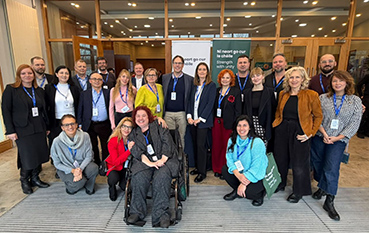
The European Network of Social Integration Enterprises (ENSIE) is celebrating its 25th anniversary, marking a quarter of a century of work in support of the social and labour market inclusion of people who face barriers to employment. Since its foundation in Belgium in 2001, the organisation has grown to bring together more than 30 members from different European countries and has established itself as a recognised stakeholder in European civil society and social dialogue.
To mark this anniversary, ENSIE President Duncan Walker has reflected on the organisation’s journey, the sector’s progress and the challenges that will shape its future. Walker, who represents the Irish Social Enterprise Network (ISEN), an ENSIE member since 2016, took up the presidency in May 2025. His career is closely linked to Work Integration Social Enterprises: he previously managed Green Kitchen Cafe and Garden Centre, an organisation in Dublin that provides training, work experience and employment opportunities for people with intellectual disabilities and others who are distant from the labour market.
For Walker, ENSIE’s 25 years represent an remarkable achievement and recognition of the collective efforts of all the people and organisations that have contributed to building the network. He particularly highlights its growth and its ability to influence European policies in areas such as public procurement, State aid rules, quality employment, the Social Economy Action Plan and the European Pillar of Social Rights.
The B-WISE project: a step forward for the sector
Among ENSIE’s main achievements, its President highlights the organisation’s ability to secure greater institutional recognition for the sector at European level. In this regard, he particularly points to the B-WISE project, whose inclusion in the European Blueprint process, together with the provision of dedicated funding, marked an important step towards greater recognition of Work Integration Social Enterprises.
The knowledge, data and findings generated by the project constitute, in Walker’s words, a highly valuable resource that will continue to contribute to the work of ENSIE, its members and its policy advocacy initiatives for years to come.
A collective voice that is more necessary than ever
The ENSIE President warns that the current political context makes having a strong collective voice to defend the social economy and Work Integration Social Enterprises even more important.
As he points out, European political discourse is increasingly shifting its focus away from social issues towards priorities such as competitiveness, defence and global challenges. The proposals for the next Multiannual Financial Framework and the dismantling of the European Social Fund are, in his view, examples of the difficulties facing the sector.
Against this backdrop, Walker considers it essential to strengthen advocacy for WISEs, whose role is fundamental to building truly inclusive communities, particularly in a context marked by growing social and political divisions. Supporting organisations that work with the most vulnerable people must remain a priority.
The next 25 years: more opportunities and new challenges
Looking ahead, Walker expects building inclusive communities in Europe to become increasingly difficult. ENSIE and its partner organisations will therefore need to intensify their awareness-raising and policy advocacy efforts.
At the same time, he believes there is an opportunity for WISEs to stop being perceived as a minority presence in the business world and to take on a more prominent role in the economy.
To achieve this, he identifies several priorities: improving the competitiveness of Work Integration Social Enterprises, strengthening public and private procurement to expand their market opportunities, and promoting a business environment that places greater emphasis on social responsibility.
On this last point, Walker insists that labour market inclusion should not be the sole responsibility of WISEs. Mainstream businesses also have a fundamental role to play in creating employment opportunities for everyone, including those in the most vulnerable situations.