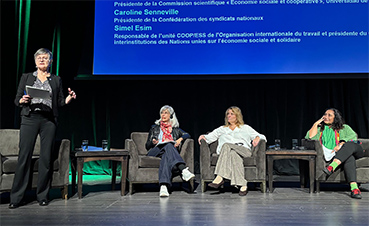
Montreal (Canada) hosted the 35th CIRIEC International Congress from 5 to 8 October 2026, one of the leading international events dedicated to the study of the social economy, the public economy and economic democracy. The event took place at the Mont-Royal Convention Centre, with close to 1,000 participants from thirty countries. During the Congress, the CIRIEC-International Assembly elected Marc Picard as its new president, succeeding Bernard Thiry.
Organised by CIRIEC-Canada, the Congress provided an international forum for dialogue among researchers and practitioners, as well as for sharing experiences from Quebec and numerous other national contexts. The sessions examined the role of public enterprises and social economy organisations in building more inclusive, resilient and sustainable societies, against a concerning backdrop marked by geopolitical crises and ongoing wars, the erosion of democracies and political polarisation, growing inequalities, climate change and environmental impacts, as well as technological challenges, among other issues.
Key topics discussed included the socio-ecological transition and the circular economy, sustainable finance, democratic governance, care and gender equality, housing, digital transformation and responsible artificial intelligence. The programme also focused on the role of public policies in developing the social economy and the contribution of public enterprises to the provision of essential services, such as energy, transport and infrastructure.
The diversity of experiences presented highlighted the relevance of economic models that place the collective interest and people’s well-being at the heart of their activities. The discussions also underscored the need to strengthen international cooperation and make further progress in the effective implementation of social economy policies and strategies.
Marc Picard, new president of CIRIEC-International
One of the Congress’s key institutional milestones was the election of Marc Picard as the new president of CIRIEC-International during the CIRIEC General Assembly held on 6 October. Picard succeeds Bernard Thiry at the helm of the organisation, which has promoted research and international exchange in the public, social and cooperative economy since 1947.
President of CIRIEC-Canada since 2022, Marc Picard has also served as chief executive officer of Caisse d’économie solidaire Desjardins since 2013. His professional career is closely linked to the development of collective enterprises, solidarity-based finance and the strengthening of organisations committed to a fairer and more sustainable economy.
His election opens a new chapter for CIRIEC-International, which faces the challenge of continuing to consolidate its global network of researchers, institutions and organisations, and strengthening dialogue between the social and cooperative economy and the public economy in response to major contemporary challenges.
International scientific cooperation, a strategic priority
Alongside the Congress, the CIRIEC International Scientific Commission on the Social and Cooperative Economy, chaired by Carmen Marcuello, professor at the University of Zaragoza, met at HEC Montréal on 5 October. The meeting provided an opportunity to review ongoing research areas, strengthen international working groups and explore new opportunities for academic collaboration.
Among the highlighted initiatives was the development of a working group on gender and the social economy, which received 83 expressions of interest from all five continents. Progress was also made on the initiative focusing on the cycles of public policies for the social economy, coordinated by Professor Rafael Chaves. It received 110 expressions of interest internationally and aims to comparatively analyse the evolution of these policies and the conditions that support their effectiveness and continuity.
The Commission also discussed new research areas concerning the contribution of public enterprises and the social economy to the Sustainable Development Goals, as well as public service cooperatives and their role in providing essential services.
Another key topic was the creation of an international network of young researchers, inspired by the experience of REJIES in Spain. The initiative aims to facilitate new collaborations, publications and joint projects, as well as promote scientific meetings and share training, mobility and funding opportunities.