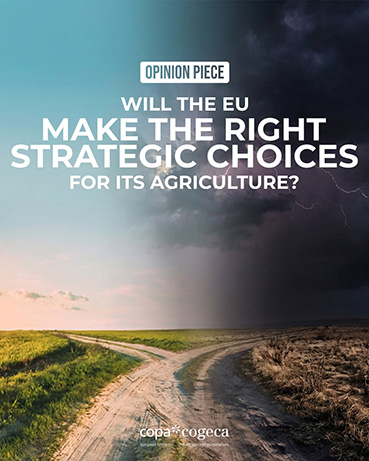
Copa-Cogeca has launched a debate on the decisions that, in its view, the European Union must address regarding the future of its agriculture. It set out its position in an article published on 1 September, entitled “Under mounting pressure, Europe is approaching a defining moment: will it make the right strategic choices for its agriculture?”. The article is signed by Copa President Massimiliano Giansanti and Cogeca President Lennart Nilsson.
The position comes after a summer marked by episodes of extreme heat, droughts and fires that have affected different agricultural areas across Europe. These circumstances have further worsened market conditions in many Member States, which were already difficult. High fertiliser and energy costs have further aggravated the finances of agricultural holdings, already stretched to the limit, while wars, trade tensions and intensifying global competition are clouding both the immediate and long-term outlook.
The organisation considers that these problems are affecting the ability of European farmers to maintain their activities. Against this backdrop, some of the most consequential decisions on agricultural policy of the second von der Leyen Commission will be shaped in the coming months.
The article recalls that, in the current international context, food is increasingly being instrumentalised as a strategic weapon. Powers such as the US, China and Russia are strengthening their respective agricultural and livestock sectors in the name of their own autonomy, resilience and food security. “Yet Europe is moving in the opposite direction,” Copa-Cogeca warns.
Two processes are expected to take place during the autumn that will largely determine almost all decisions on agriculture: negotiations on the future Common Agricultural Policy (CAP) and on the EU’s next Multiannual Financial Framework (MFF). For the time being, significant budget cuts are foreseen for the CAP, along with its dilution into National and Regional Partnership Plans (NRPPs). For Copa-Cogeca, the consequence is that Europe risks ultimately weakening its historic agri-food heritage, thereby putting at risk the very objectives enshrined in the EU Treaties: ensuring a decent quality of life for farmers and livestock breeders, providing market stability, securing supply and ensuring that consumers have access to food at reasonable prices.
In this regard, the European Parliament’s latest Eurobarometer shows that inflation, rising prices and the cost of living are the top priority for 47% of Europeans, six points higher than in autumn 2025. Food prices are a fundamental part of the debate on the cost of living. Copa-Cogeca insists: “Affordable food is not achieved by weakening Europe’s capacity to produce it; it is achieved by ensuring that a competitive, productive and resilient European agriculture continues to occupy a central place among Europe’s priorities”.
Against this backdrop, Copa-Cogeca is calling for “a coherent political vision, underpinned by stable policies and predictable programmes, that gives farmers the confidence they need to invest and innovate. Otherwise, we doubt that we will have the arguments needed to continue convincing young people to join our ranks and narrow the generational gap that we will face over the next decade”.
Likewise, the MFF must recognise food production “as a strategic objective intrinsically linked to Europe’s defence, security and competitiveness”. The European Competitiveness Fund (ECF) must also play an important role in promoting the adoption of innovation (i.e. the use of data and artificial intelligence), supporting the infrastructure needed for the digital transition and the resilience of agriculture.
In October, while European leaders meet for a decisive European Council, farmers will gather in Stockholm for the European Farmers’ Congress. “We will face this hour of truth with determination, because we know what is at stake. There can be no secure Europe without a strong agricultural and livestock sector. And there can be no robust European agriculture and livestock farming without European policies that are fit for purpose,” Copa-Cogeca concludes.