
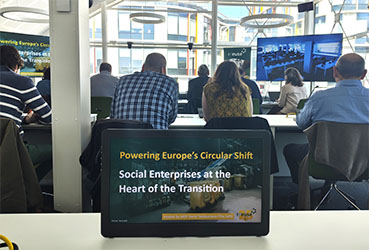
The Reuse and Recycling Network: Social Enterprises of the European Union (RREUSE) celebrated its 25th anniversary at the European Parliament with a conference focusing on the strategic role of social enterprises in the transition towards a more sustainable, resilient and inclusive circular economy. The event took place on 22 April, coinciding with Earth Day, and brought together MEPs, representatives from the European Commission and social organisations to discuss upcoming European legislative developments, including the future Circular Economy Act.
During the opening of the meeting, MEP Dario Tamburrano argued that the circular economy is key not only to environmental objectives, but also to strengthening Europe’s autonomy and resilience in the face of economic and geopolitical crises. In this regard, he highlighted the importance of recycling, reusing and repairing to reduce Europe’s dependence on external raw materials.
One of the main themes of the event was the role of social enterprises as a driving force behind more inclusive and sustainable economic models. Speaking on behalf of the European Commission, Brigitte Fellahi-Brognaux emphasised that the social economy has demonstrated its ability to combine competitiveness, inclusion and sustainability, although she warned that difficulties regarding funding and access to resources remain.
The debate also highlighted the need to reform public procurement and competition criteria to assess the social and environmental impact of sustainable projects. In this context, several MEPs criticised the fact that current market rules continue to prioritise the lowest price alone.
Circular Economy Directive
The future Circular Economy Directive was the focus of much of the discussion. MEP Delara Burkhardt warned that the legislation must not be limited to recycling and called for measures against overproduction and waste, particularly in the textile sector.
For his part, Bruno Tobback highlighted the potential of the circular economy to generate local and inclusive employment, whilst Sirpa Pietikäinen advocated for tax reforms and products designed to last longer, be repaired and reused.
After 25 years of RREUSE’s work, the meeting concluded with a shared consensus: the challenge is no longer to demonstrate the value of social enterprises in the circular economy, but to ensure that future European policies effectively support their development and expand their social and environmental impact.