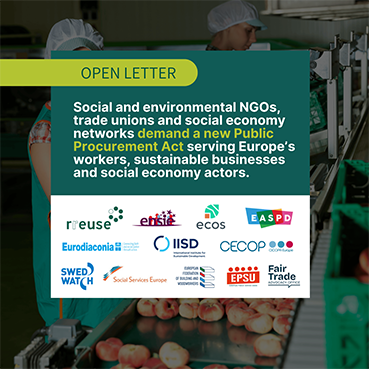
A coalition of social, trade union and environmental organisations, including ‘Social Services Europe’, RREUSE and ENSIE, has urged the European Union to take advantage of the upcoming reform of public procurement legislation to transform the European economic model towards a more sustainable, fair and competitive one.
In a letter addressed to the European Commission, specifically to the Executive Vice-President and Commissioner for the Internal Market, Stéphane Séjourné, and the Head of Unit for Public Procurement, Henning Ehrenstein, the signatory entities — integrated within the network for sustainable development in public procurement — highlight that public spending represents approximately 16 % of the EU’s GDP. Therefore, they consider that the way these resources are invested has a decisive impact on the social, economic and environmental fabric of the continent.
The document points out that the current system presents significant shortcomings, such as competition based exclusively on the lowest price, which has led to a “race to the bottom”, with negative consequences for service quality, workers’ rights and business sustainability.
In response to this situation, the organisations propose five key reforms. Firstly, they call for the main award criterion to be the Most Economically Advantageous Tender – Most Economically Advantageous Tender (MEAT), instead of the lowest price, in order to ensure better value for money and a long-term approach in the public interest.
Secondly, they advocate for the mandatory introduction of social and environmental criteria in procurement procedures. These must ensure fair wages, decent working conditions and decarbonisation measures, as well as control mechanisms in supply chains and limits on subcontracting.
Another priority highlighted is to facilitate access for the social economy to public procurement. This sector, which brings together more than 4.3 million entities and employs 11.4 million people in Europe, according to the latest report by CIRIEC and Euricse for the Commission, plays a key role in social cohesion and inclusive innovation. The organisations propose specific measures, such as reserving contracts for vulnerable groups, including persons with disabilities.
Furthermore, the text underlines the need to align public procurement with other existing European policies, such as the Clean Industrial Deal, the European Pillar of Social Rights and new regulations on sustainability and the circular economy.
Finally, it stresses the importance of strengthening monitoring and transparency systems. In this regard, Member States are called upon to establish mandatory mechanisms for data collection and impact assessment of public procurement, in order to ensure the efficient use of public funds and compliance with social and environmental objectives.
The signatory organisations conclude that the future reform represents a historic opportunity to turn public procurement into a strategic tool serving a more resilient, inclusive and environmentally friendly European economy.