
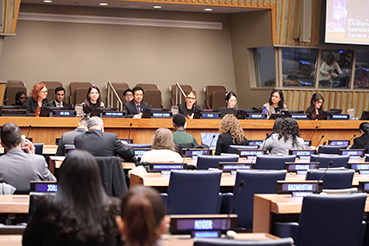
The 64th session of the Commission for Social Development (CSocD64), held last 9 February at the UN headquarters in New York, highlighted the urgency of adopting an approach involving the whole of government and the whole of society to eradicate poverty, promote decent work for all and foster social inclusion, as reaffirmed by the Doha Political Declaration, published in November during the second World Summit for Social Development, which places cooperatives at the centre as one of the models capable of driving change.
During the Multistakeholder Forum, a panel was held which, moderated by Jeroen Douglas, Director General of the International Cooperative Alliance (ICA), analysed different financing options for development, as well as the role of accountability in government and society, and how to include cooperatives more deliberately within national social and economic agendas.
Participants shared practical examples of how cooperatives can contribute to a better world by creating jobs, building inclusive societies and addressing the root causes of poverty, although they pointed out that greater governmental and societal support is needed to scale up their impact.
Douglas stated that the Doha Declaration is “not just another document”, but “a plan for people”, recognising that social justice and poverty eradication are only possible through an approach involving the whole of society, and recalled that the ICA promotes a shift from traditional aid towards investment models based on resilience, highlighting examples such as savings and credit cooperatives reaching remote areas, cooperative financial mechanisms mobilising capital ethically, and the Coop Exchange network to facilitate access to finance.
In his conclusions, Douglas identified three key pillars: development based on dignity, democratisation of data and recognition of cooperatives as permanent economic infrastructure, insisting that not only temporary projects should be funded, but that lasting movements must be invested in.
International support
Among the participants in the debate, Nicolas Roguet, from the canton of Geneva, stressed the importance of diversifying financing, warning of the challenges arising from the reduction of public resources and the need for private co-financing. He also underlined the importance of citizen participation under the principle “Nothing about us without us”.
The representative of Türkiye, Nihal Janset Güven, replied that her country’s strategy against poverty is based on leaving no one behind and on multistakeholder coordination integrating central government, local authorities, civil society and the private sector, and invited participants not to overlook digital systems and the empowerment of women in the equation.
For her part, Amy Niang, from The Africa Institute, warned that the comprehensive approach will only be effective if there are robust legal frameworks enabling citizens to defend their rights, and added that the informal economy already contains advanced social protection systems which must be connected with formal systems without eroding their autonomy.
Fabiola da Silva Motta, the Brazilian representative, highlighted the role of credit unions in local development and poverty reduction, whose growth has been made possible thanks to collaboration with the government.