
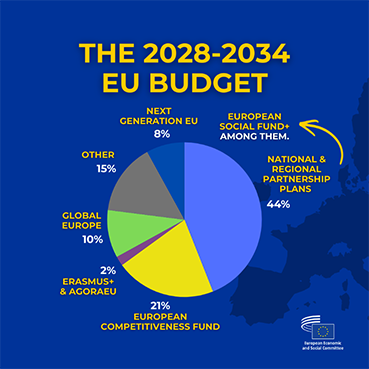
The negotiations on the 2028-2034 Multiannual Financial Framework (MFF) will be decisive in determining whether the EU’s next long-term budget can effectively address the challenges facing the European Union. In this context, and drawing on its recent policy contributions and its participation in the Time for Ambition coalition, Social Economy Europe (SEE) calls for an MFF that strengthens social investment, safeguards cohesion policy and recognises the social economy as a key driver of competitiveness, economic autonomy and defence of the EU values enshrined in Article 2 of the EU Founding Treaty.
A core expectation is the explicit recognition of the social economy as a structural contributor to EU competitiveness and economic sovereignty. Social economy actors combine social objectives with economic performance, through democratic governance and the reinvestment of surpluses for social purposes.
They anchor economic activity locally, strengthen value chains, reduce strategic dependencies and contribute to Europe’s economic autonomy and competitiveness, while supporting social cohesion and resilience.
Therefore, for SEE, the MFF must ensure that social economy organisations can effectively access funding under cohesion policy, including the European Social Fund Plus (ESF+), the European Regional Development Fund (ERDF), InvestEU, the European Competitiveness Fund (ECF), the Single Market and programmes supporting digitalisation, regardless of whether they ultimately form part of the National and Regional Partnership Plans or not.
SEE strongly underlines the need to safeguard cohesion policy and to maintain and reinforce ESF+ earmarking for social inclusion, quality employment, skills development and the fight against poverty. Weakening ESF+ or diluting its social objectives would undermine both social cohesion and long-term competitiveness. The MFF must be closely aligned with the implementation of the European Pillar of Social Rights (EPSR) and the green and digital transitions.
Finally, SEE emphasises that EU Defence is also about defending the Union’s values and must therefore go hand in hand with social investment. Fighting poverty, reducing inequalities and ensuring access to quality jobs and services are fundamental to social trust, civic participation and democratic resilience. For this reason, social economy organisations play a crucial role in strengthening local democracy and social cohesion, particularly in times of growing polarisation.