The 7th edition of the Global Social and Solidarity Economy Forum (GSEF 2025) concluded with the publication of three documents marking a new horizon for the international SSE movement: the Bordeaux Declaration, the Declaration for Lasting Peace, and the International Youth Declaration for SSE. All three convey a unified message: in the face of ecological, social, and political crises, the Social and Solidarity Economy stands as a concrete alternative for justice, sustainability, and cooperation among peoples.
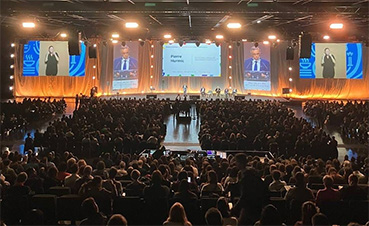
Gathered in the French city were over 10,000 delegates from 109 countries and 907 cities – including local governments, civic networks, social economy organizations, and committed youth – all affirming their commitment to building an economy that places life and dignity at its core.
Bordeaux Declaration – GSEF 2025
The final GSEF 2025 declaration positions the Social and Solidarity Economy (SSE) as a true social transformation project in a world marked by growing inequalities and ecological degradation. Signatories warn that “seven of the nine planetary boundaries have already been exceeded” and that democracies are receding, yet emphasize that the future can still be written differently.
The text advocates SSE as an economy of dialogue and peace, capable of acting as a social stabilizer, reducing tensions, and rebuilding cohesion in times of crisis. Recalling the ILO Philadelphia Declaration, it asserts that there is no lasting peace without social justice.
Participants commit to concrete actions: strengthen local SSE ecosystems, promote cooperative education, create exchange platforms between cities, and support a just socio-ecological transition. They also call on states, local governments, and international organizations to integrate SSE into structural policies with specific legal and fiscal frameworks, public funding, and co-governance spaces.
The text emphasizes the need for cooperative education and culture, youth participation, and global inter-cooperation. According to the signatories, SSE is “a vitamin for our democracies” and a concrete way to rebuild the link between economy, society, and environment.
Declaration for Lasting Peace
The second GSEF 2025 declaration, for lasting peace, begins with a strong denunciation: in many countries, humanity and nature remain victims of wars, genocides, and structural inequalities. The text proposes SSE as an economy of peace, based on cooperation, fair redistribution, and economic democracy.
It presents a deep critique of the “predatory and authoritarian economic model that fuels conflict, exclusion, and the climate crisis.” Alongside the absence of economic democracy are political selfishness and excessive consumption of natural resources, exacerbating global inequality. In contrast, SSE offers a redistributive economy, respectful of life and commons, capable of building solidarity among communities.
Concrete examples include cooperatives, fair trade, networks hosting migrants and refugees with dignity, and entities supporting ecological and digital transitions with an ethical approach. In each case, SSE demonstrates its ability to prevent conflicts and rebuild social fabric through participation, decent work, and gender equity.
The text concludes with a global call for world leaders to adopt policies for a redistributive and resilient economy, and for GSEF itself to establish an international working group on peace and SSE.
International Youth Declaration for SSE
The third text, prepared by GSEF’s Young’ESS Network, reflects the voices of youth from five continents involved in GSEF preparatory processes from 2024–2025. Its preamble states the signatories’ conviction that SSE is “a key pathway for social, environmental, and political transitions” and an essential instrument for achieving the UN 2030 Agenda.
The document is structured around six pillars:
- Dignified life and social justice, with proposals to ensure universal social protection, gender equality, and fair wealth redistribution.
- Decent work and economic empowerment.
- Education and knowledge transfer, integrating SSE into formal and non-formal education, fostering creativity and critical thinking.
- Protection of life and the planet, including agroecology, food sovereignty, and youth participation in climate governance.
- Participation and democratic governance, with youth co-decision in public policies.
- Building peace and solidarity among peoples, through intercultural dialogue, solidarity mobility, and recognition of cultural diversity.
The text concludes with a call for governments to recognize youth as a transformative force and “engine of SSE” worldwide. “If the Social and Solidarity Economy is the means to achieve the SDGs, let youth be its driving force,” the document states.