
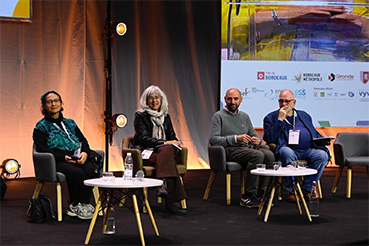
The 10th CIRIEC International Research Conference on Social Economy, held on October 27–29 in Bordeaux, and the GSEF Bordeaux 2025 (Global Social and Solidarity Economy Forum), held from October 29–31, made the French city the world capital of the Social and Solidarity Economy.
The 10th CIRIEC International Research Conference on Social Economy of CIRIEC International was primarily hosted at Sciences Po Bordeaux, gathering over 400 participants from 47 countries. Under the theme “The Role of the Social and Solidarity Economy (SSE) in the Socio-Ecological Transition,” the three-day event included around ten plenary sessions and 56 workshops, presenting 280 research projects by social economy experts.
The Conference’s thematic axes covered a broad and ambitious approach, aiming to identify solutions that could enhance the growth of the social economy and its contribution to the pressing challenges facing the planet and humanity today (climate, social, political crises, wars…). Topics included sessions on SSE statistics and social impact; financing and business models; networks and public policies; decent work; care economy; public-private collaboration with social economy; and gender studies.
The opening session, hosted by Dominique Darbon, Director of Sciences Po Bordeaux (France), featured speeches by Timothée Duverger, Chair of the Conference Scientific Committee; Alain Arnaud, President of CIRIEC-France; Françoise Jeanson, Vice President of Education and Research for Nouvelle-Aquitaine; Marie-Laure Cuvelier, SSE Delegate of Nouvelle-Aquitaine; and Bernard Thiry, President of CIRIEC International.
As they noted, the 10th CIRIEC International Research Conference on Social Economy marks a significant milestone, celebrating a decade of academic and professional collaboration around the study and promotion of the Social and Solidarity Economy. From Vancouver (2007) to Seoul (2023), the CIRIEC International Scientific Conference has helped consolidate the concept of Social Economy and its recognition as the third major pillar of the economy, alongside the traditional public sector and the purely capitalist private sector, with the capacity to meet the needs of billions of people and balance social, environmental, and economic goals.
During the first plenary on Territorial Responsibility, Carmen Marcuello, Chair of the CIRIEC-International Scientific Commission on Social Economy and Cooperatives and Vice President of CIRIEC-Spain, and Saoia Arando, from Mondragon University and the ASETT Vanguard Hub, shared the panel with Juan Fernando Álvarez, from Pontificia Universidad Javeriana and CIRIEC-Colombia, and Maryline Filippi, from Bordeaux Science Agro.
Using examples from Spain, Colombia, and France, they promoted a development approach where the territory is not just a geographic space, but a social fabric with organized actors (communities, cooperatives, associations) co-deciding public policies. “Co-construction” means that territorial actors, including solidarity organizations, cooperative networks, and social economy actors, actively participate in defining objectives, regulatory means, and institutional forms of public intervention. Furthermore, for SSE to have a real impact, there must simultaneously be cognitive strengthening through education, research, and knowledge transfer, as well as institutional recognition of its solidarity practices.
ILO-CIRIEC Session on Statistics
Another key Conference session was co-organized by the ILO and CIRIEC on SSE statistics. Moderated by Simel Esim, Head of the ILO’s Cooperatives, Social and Solidarity Economy Unit, the panel featured Marie J. Bouchard, Université du Québec à Montréal (UQAM) and CIRIEC-Canada; Nawon Lee and Hyungsik Eum, ILO; and Rafael Chaves-Avila, Professor at Universitat de València and Chair of CIRIEC-Spain Scientific Commission.
Both the ILO and CIRIEC have made significant efforts in statistics in recent years. The ILO’s 2023–2029 Action Plan (“Strategy and action plan on decent work and the SSE”) prioritizes statistical improvement. It has established two specialized technical groups—one for cooperatives and one for the social and solidarity economy—to develop harmonized statistical frameworks. The results are expected to inform international statistical standards, especially ahead of the 2028 International Conference of Labour Statisticians (ICLS).
Professor Chaves reviewed CIRIEC’s work in statistical information, from Social Economy White Papers, Satellite Account Manuals, statistical web portals like CIRIECSTAT, and EU studies, the latest being Benchmarking the socio-economic performance of the EU Social Economy, presented last year with Euricse.
Joint CIRIEC-GSEF Day
The CIRIEC Conference concluded at Palais de l’Atlantique 2 in Bordeaux, coinciding with the GSEF 2025 inaugural session. The unprecedented event brought together 10,800 participants, 907 cities, and 109 countries. Throughout the week, the city became a global meeting point for people giving life to a fairer, more sustainable, and more humane economy.
Bordeaux Mayor and GSEF President Pierre Hurmic emphasized the urgency of a model shift in a world “ripping apart everywhere” and advocated for equitable public funding of SSE: “€200 billion for companies in France, only €16 billion for SSE,” he warned.
Benoît Hamon, President of ESS France, framed the Forum globally: “We face a new stage of global capitalism, where the alliance between the US and tech giants threatens democracy and social bonds.” He called for an “unprecedented responsibility of SSE to observe the times and chart a path,” safeguarding rights and economic democracy.
Social Economy Europe (SEE) was strongly present, participating in key debates and sharing the European perspective. SEE President Juan Antonio Pedreño delivered the inaugural speech on the importance of social economy in Europe and worldwide. Citing the latest CIRIEC and Euricse report, he noted that in the EU, social economy comprises 4.3 million enterprises and entities, generating 6.5% of employment and nearly €1 trillion in revenue. “This cannot be ignored,” he warned, adding that social economy “cannot bear the cost of current global excesses,” and its values must be amplified and placed at the center of the transition to a fairer, more inclusive, and sustainable future for all.
The Conference concluded with announcements of CIRIEC International’s upcoming events: the 35th International Congress on Public, Social, and Cooperative Economy in October 2026 in Montreal (Canada), and the 11th International Research Conference on Social Economy in 2027 in Bogotá (Colombia).